
Preserving Family Integrity: Constitutional Visitation Rights of Incarcerated Parents
Incarcerated parents face unique barriers in maintaining their relationship with their children. One of the most significant obstacles is the denial or restriction of visitation rights, which not only disrupts family bonds but also increases the likelihood of permanent separation through foster care or adoption. Courts have long recognized that family integrity is a fundamental liberty interest, protected under the United States Constitution.

Fewer Chutes, More Ladders
This report, “Fewer Chutes, More Ladders,” frames a set of persistent problems facing youth in our state through a simple metaphor: “chutes” are the sudden setbacks associated with the “school-to-prison pipeline”—arrests, suspensions, expulsions, incarcerations—that push young people away from opportunity, while “ladders” are the supports, programs, and relationships that help them climb toward a hopeful future in terms of education, employment, and economic security.
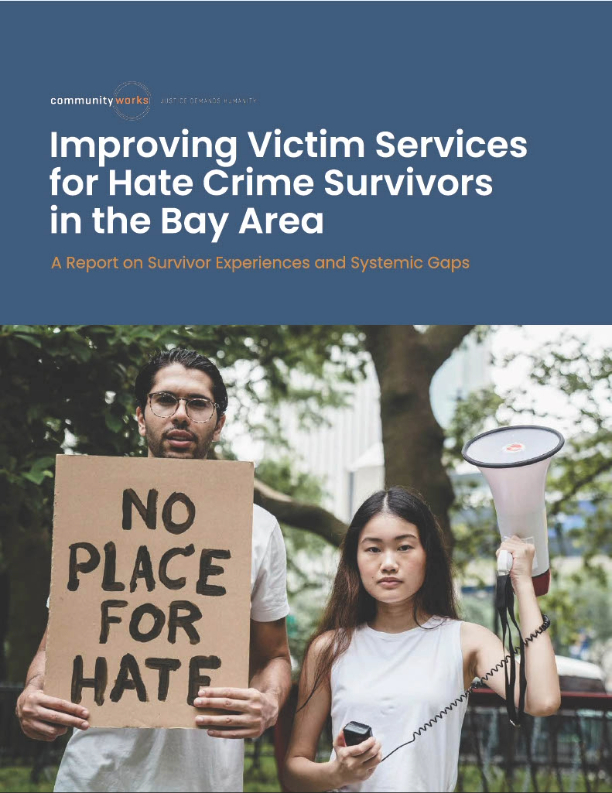
Improving Victim Services for Hate Crime Survivors in the Bay Area: A Report on Survivor Experiences and Systemic Gaps
This report presents findings from a combination of compiling publicly available information, conducting interviews with representatives from the Victim Services Divisions (VSD) in the District Attorney Offices of Alameda, Contra Costa, and San Francisco counties, facilitating focus groups for survivors, and collecting responses from survivors through a digital survey. The aim is to take stock and inventory existing services available to crime survivors locally, highlight challenges…
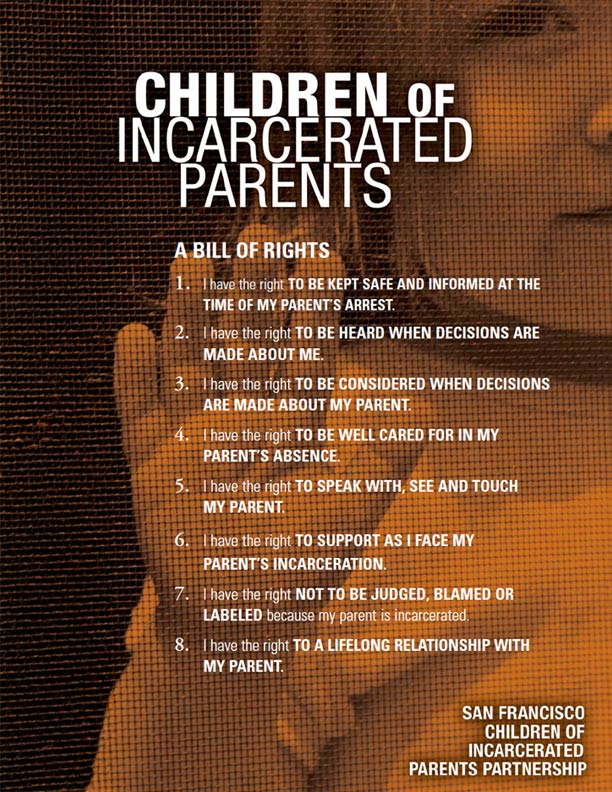
Children of Incarcerated Parent: A Bill of Rights
The San Francisco Children of Incarcerated Parents Partnership (SFCIPP) is a coalition of social service providers, representatives of government bodies, advocates and others who work with or are concerned about children of incarcerated parents and their families. Formed in 2000 under the auspices of the Zellerbach Family Foundation, SFCIPP works to improve the lives of children of incarcerated parents, and to increase awareness of these children,their needs and their strengths. After studying the issues affecting these children and their families, SFCIPP members agreed…

Property Crime Reached Record Lows In 2024 — Before Prop 36 Even Took Effect
A decade of crime trends through 2024 refute the widespread alarm driven by viral videos, sensational news reports, anecdotes, and quips that 2014’s Proposition 47 reform increased property crimes. Property crime rates declined during much of the criminal justice reform era1 to reach record-low levels last year. While these rates fluctuated during the COVID-19 shutdowns and reopenings, they improved in 2023 and 2024. California’s larger public safety trends…
Justice for All: How Restorative Justice Mutually Benefits Victims and Youth
Restorative justice is an alternative approach to addressing crime focused on repairing harm and restoring relationships. From international peacemaking tribunals to the school playground, restorative frameworks can be adapted to fit almost any situation. Empirical, up-to-date evidence on restorative practices is necessary to design programs that hold people accountable and address the needs of all stakeholders in ways that the traditional justice…
Can Restorative Justice Conferencing Reduce Recidivism? Evidence From the Make-it-Right Program
This paper studies the e ect of a restorative justice intervention targeted at 143 youth ages 13 to 17 facing felony charges of medium severity (e.g., burglary, assault). Eligible youths were randomly assigned to participate in the Make-it-Right (MIR) restorative justice program or a control group where they faced standard criminal prosecution. We estimate the e ects of MIR on the likelihood that a youth will be rearrested in the four years following randomization.
Model Practices for Parents in Prisons and Jails: Reducing Barriers to Family Connections
Recent studies have found that 2.7 million children in the United States have a parent serving time in prison or jail at any given time, while more than 5 million children have experienced parental incarceration at some point during their lives.1 Parental incarceration is often stressful and traumatic for children as it can create or contribute to economic and social disruptions in their lives. In many cases, children may lose a source of financial or emotional support, be forced to move in with another parent or caregiver…
California Crime Survivors Speak: A Statewide Survey of California Victims’ Views On Safety and Justice
Protecting victims of crime and promoting public safety is the most important function of the California criminal justice system. It is therefore essential to consider the experiences and perspectives of crime survivors when determining safety and justice policy. To fill the gap in knowledge of victims’ experiences and needs, Californians for Safety and Justice conducted the first-ever research survey of California crime victims in 2013. The statewide survey revealed that the majority of crime victims in California…

Restorative Community Conferencing: A study of Community Works West’s restorative justice youth diversion program in Alameda County
This report, written by Impact Justice’s Restorative Justice Project, explores Community Works West’s Restorative Community Conferencing program, which currently diverts over 100 youth per year away from the juvenile legal system. Restorative Community Conferencing (RCC) is a process for resolving harm through an organized, facilitated dialogue in which young people, with the support of family and community members, meet with their crime victims to create a plan to repair the harm caused by their offense.

Winning the Narrative on Safety, Accountability, and Justice: Leading with solutions, not scare tactics
Safety is too important an issue to be politicized, yet it always is. Conventional wisdom in the media and among the political class about what communities think about crime is wrong. We need to win the politics on crime to pass policy change for safety, accountability, and justice. This report offers various strategies, ideas, and takeaways. It presents statistics, data, and research on safety in our communities and on alternatives to more draconian policy and legislation.
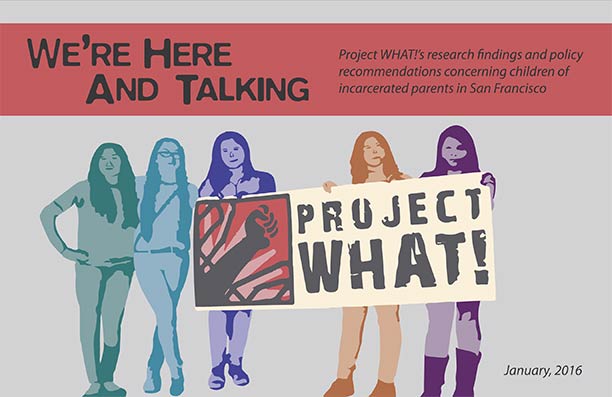
Project What: A Program of Community Works
We are Project WHAT! Youth Advocates. All of us have had a parent incarcerated either currently or in the past. We have a vision for a better San Francisco, one where our cities’ youth with incarcerated parents are able to live free of judgment and blame. We have a vision where our city prioritizes supporting vulnerable populations, rather than punishing them. As youth who have the most direct experience of what it’s like to grow up with a parent behind bars, we have made it our top priority to make this vision a reality.
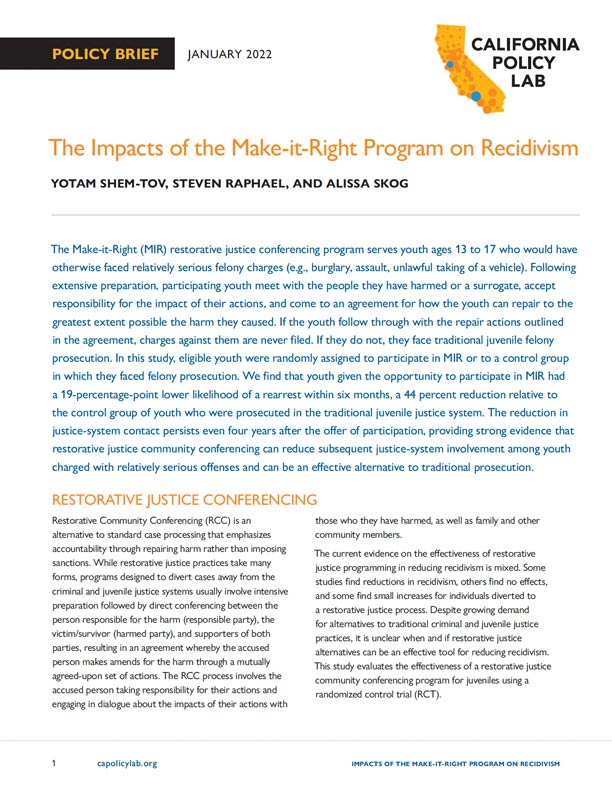
The Impacts of the Make-it-Right Program on Recidivism
The Make-it-Right (MIR) restorative justice conferencing program serves youth ages 13 to 17 who would have otherwise faced relatively serious felony charges (e.g., burglary, assault, unlawful taking of a vehicle). Following extensive preparation, participating youth meet with the people they have harmed or a surrogate, accept responsibility for the impact of their actions, and come to an agreement for how the youth can repair to the greatest extent possible the harm they caused.